

Soil-Health Climate-Resilient Fertility Programs Market to Reach USD 4,328.2 million by 2036
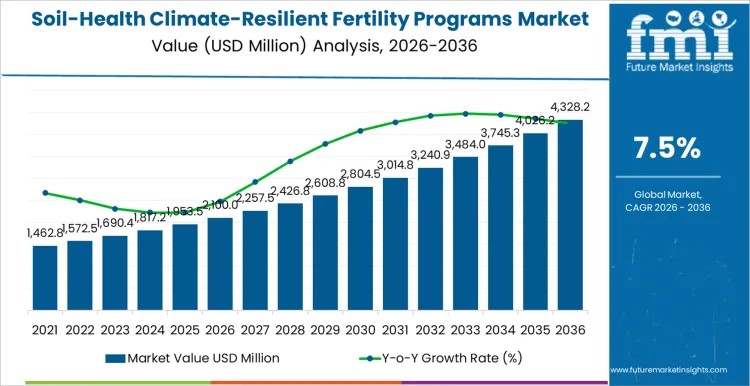
Soil-Health Climate-Resilient Fertility Programs Market
Global market forecast shows 7.5% CAGR through 2036, driven by carbon markets, climate adaptation needs, and data-driven soil management programs.
NEWARK, DE, UNITED STATES, January 21, 2026 /EINPresswire.com/ -- The global soil-health climate-resilient fertility programs market is forecast to grow from USD 2,100.0 million in 2026 to USD 4,328.2 million by 2036, registering a compound annual growth rate (CAGR) of 7.5% over the ten-year period. The outlook reflects rising demand for integrated fertility systems that address climate variability, improve soil biological function, and support long-term agricultural productivity through verified environmental and economic outcomes.
Agricultural producers are increasingly shifting from conventional fertilizer application toward holistic soil ecosystem management. These programs combine nutrient optimization, soil biological enhancement, carbon sequestration, and outcome monitoring to strengthen farm resilience, meet regulatory requirements, and improve operational sustainability.
Request For Sample Report | Customize Report |purchase Full Report - https://www.futuremarketinsights.com/reports/sample/rep-gb-31602
Market Context: Why Soil-Health Fertility Programs Are Gaining Traction
• Soil-health climate-resilient fertility programs are designed to deliver ecosystem services, adaptive management protocols, and measurable performance verification. They address mounting pressures from climate change, environmental regulation, and input cost volatility by integrating fertility management with soil carbon accumulation, biodiversity enhancement, and nutrient cycling efficiency.
• Large-scale and medium-scale farms are adopting precision monitoring technologies, soil biological assessment protocols, and climate-adaptive management systems to guide data-driven fertility decisions. These tools allow producers to track soil health improvements, climate resilience benefits, and economic returns, enabling earlier integration of fertility programs into farm planning and investment strategies.
• The market’s growth is also closely tied to the maturation of carbon credit markets. As soil carbon sequestration becomes measurable and economically valuable, fertility strategies are increasingly evaluated not only on yield performance but also on their contribution to carbon accumulation and climate mitigation.
Key Market Metrics and Growth Outlook
• Market Value (2026): USD 2,100.0 million
• Forecast Value (2036): USD 4,328.2 million
• Forecast CAGR (2026–2036): 7.5%
• Leading Program Type: Input-linked programs (38% market share)
• Leading Channel: Crop consultants and agricultural advisors (34%)
• Largest Farm Segment: Medium-scale farms (36%)
Nutrient management programs account for 32% of market share, driven by their role in optimizing fertilizer efficiency and meeting environmental compliance standards. Soil-health and organic matter programs follow with 30% adoption, reflecting demand for long-term productivity enhancement and biological soil restoration.
Carbon Markets Reshaping Fertility Strategies
Carbon credit market development is transforming fertility management by linking soil carbon sequestration to financial returns. Modern carbon programs require comprehensive soil monitoring, practice verification, and outcome measurement, encouraging integration between fertility programs and carbon accounting systems.
These frameworks reward farmers for adopting practices that increase organic matter and soil biological activity, creating additional revenue streams while supporting climate mitigation objectives. Fertility programs that demonstrate verified carbon accumulation are gaining competitive advantage as carbon market participation expands.
Program Delivery Models and Market Structure
Input-linked programs dominate the market with a 38% share, combining fertilizer supply with technical services, monitoring, and outcome verification. This model reduces transaction complexity for farmers while supporting economies of scale in service delivery.
Advisory and digital services, monitoring and verification packages, and outcome-based contracts represent other major offering categories. Together, these models reflect a shift toward accountability-based fertility services with measurable performance benchmarks.
Crop consultants and agricultural advisors remain the primary delivery channel, accounting for 34% of market access. Their established agronomic relationships and localized expertise support customized recommendations and long-term farmer engagement.
Regional Growth Patterns and Country-Level Outlook
The market shows distinct regional growth patterns shaped by agricultural scale, policy frameworks, and climate adaptation requirements:
• China: 8.7% CAGR, driven by large-scale production needs and government policies promoting sustainable farming and carbon sequestration.
• United States: 7.3% CAGR, supported by precision agriculture adoption and climate-smart farming initiatives.
• Germany: 7.1% CAGR, reflecting strong soil protection regulations and advanced research infrastructure.
• United Kingdom: 7.2% CAGR, influenced by environmental compliance and climate adaptation programs.
• South Korea: 6.7% CAGR, supported by smart farming technologies and sustainability policies.
• Japan: 6.0% CAGR, driven by quality-focused agriculture and precision soil management practices.
Regulatory and Climate Adaptation Drivers
Environmental regulations related to water quality, greenhouse gas reduction, and biodiversity conservation are creating demand for fertility programs that can demonstrate verified compliance. Payment programs for environmental services further strengthen market incentives by compensating farmers for soil carbon sequestration and ecosystem improvements.
Climate adaptation needs are also accelerating innovation in soil management strategies that enhance water-holding capacity, drought tolerance, and nutrient availability under stress conditions. These pressures favor fertility programs that integrate soil health improvement with climate risk management.
Competitive Landscape and Key Participants
Market leadership is shaped by comprehensive service integration, digital monitoring capabilities, and outcome verification technologies. Key companies operating in the global soil-health climate-resilient fertility programs market include:
• Yara International
• Nutrien
• Corteva Agriscience
• Bayer Crop Science
• Syngenta Group
• Indigo Ag
• Granular (Corteva)
• Trimble Agriculture
• Raven Industries (CNH Industrial)
• Farmers Edge
These providers compete on research capabilities, data analytics, monitoring platforms, and service integration models designed to deliver measurable soil health and climate resilience benefits.
Outlook
The soil-health climate-resilient fertility programs market is expected to expand steadily through 2036 as carbon markets mature, climate risks intensify, and regulatory standards evolve. Programs that combine fertility optimization with verified environmental outcomes are likely to remain central to agricultural sustainability strategies, shaping investment decisions across major farming regions worldwide.
Browse Related Insights
Vegetable Seed Market: https://www.futuremarketinsights.com/reports/vegetable-seed-market
Biscuits and Crackers Market: https://www.futuremarketinsights.com/reports/biscuits-and-crackers-market
Insect Oil Market: https://www.futuremarketinsights.com/reports/insect-oil-market
About Future Market Insights (FMI)
Future Market Insights, Inc. (FMI) is an ESOMAR-certified, ISO 9001:2015 market research and consulting organization, trusted by Fortune 500 clients and global enterprises. With operations in the U.S., UK, India, and Dubai, FMI provides data-backed insights and strategic intelligence across 30+ industries and 1200 markets worldwide.
Sudip Saha
Future Market Insights Inc.
+1 347-918-3531
email us here
Legal Disclaimer:
EIN Presswire provides this news content "as is" without warranty of any kind. We do not accept any responsibility or liability for the accuracy, content, images, videos, licenses, completeness, legality, or reliability of the information contained in this article. If you have any complaints or copyright issues related to this article, kindly contact the author above.
