

Herbal Tea Market to Reach USD 5.95 Billion by 2035 Amid Rising Demand for Functional Beverages
Herbal tea market
Increasing health awareness, growing preference for natural ingredients, and expanding wellness beverage consumption drive global market expansion
“Rising consumer preference for natural, functional beverages is reshaping the global herbal tea market, with demand accelerating across both traditional and modern retail channels.”
”
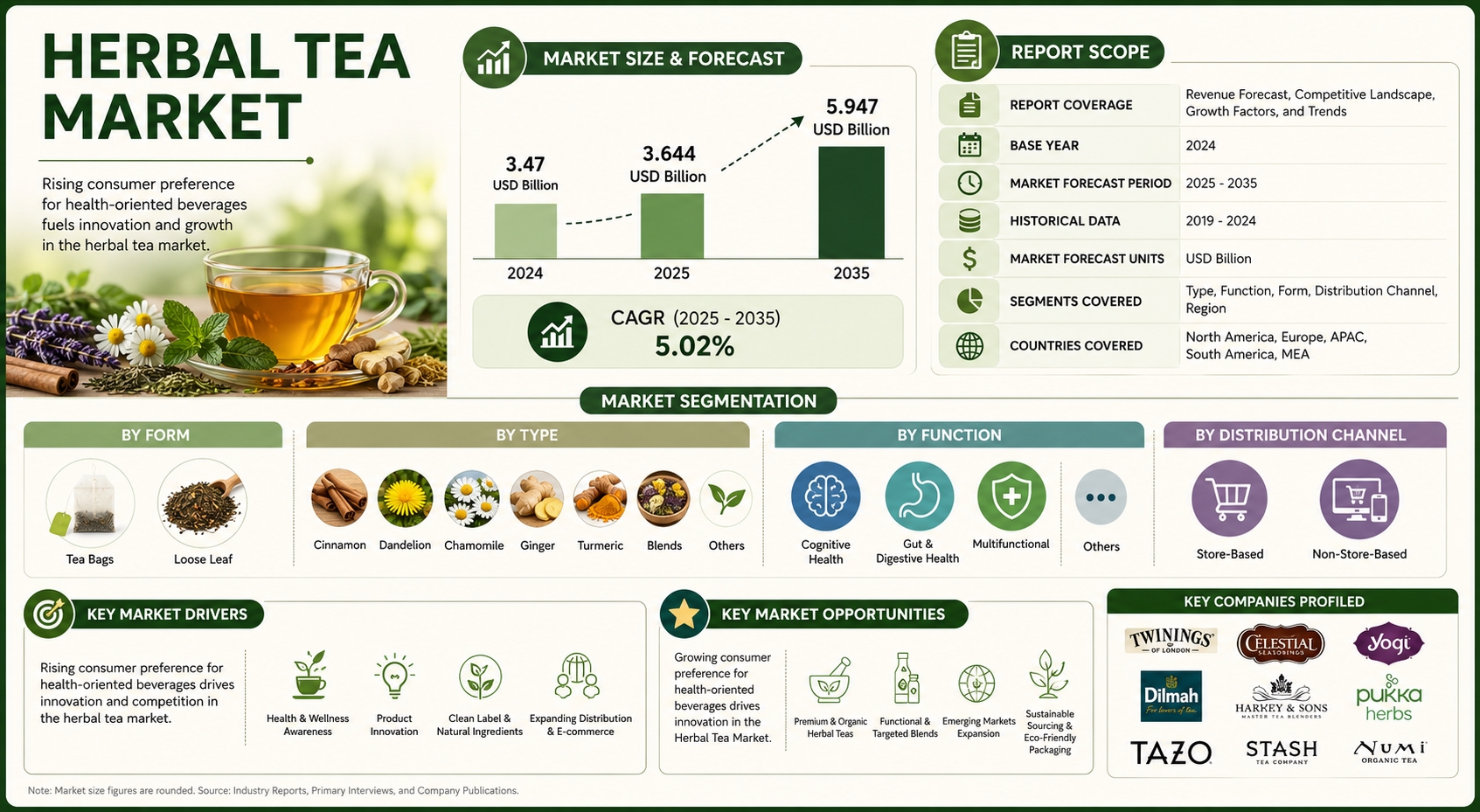
NEW YORK, NY, UNITED STATES, June 22, 2026 /EINPresswire.com/ -- The global Herbal Tea Market is witnessing steady expansion as consumers increasingly shift toward health-oriented beverages that offer functional benefits beyond basic hydration. According to recent market analysis, the global herbal tea market was valued at USD 3.47 billion in 2024 and is projected to grow from USD 3.644 billion in 2025 to USD 5.947 billion by 2035, registering a CAGR of 5.02% during the forecast period from 2025 to 2035.— Market Research Future (MRFR)
Herbal tea, made from a wide variety of botanicals, herbs, roots, spices, and flowers, has gained strong traction across global consumer markets due to its perceived health benefits, caffeine-free composition, and alignment with preventive wellness trends. Rising consumer interest in natural remedies, digestive health, cognitive support, and stress relief continues to drive product adoption across both developed and emerging economies.
Manufacturers are responding to evolving consumer preferences by expanding product portfolios, introducing innovative blends, and emphasizing organic sourcing, clean-label formulations, and functional health claims.
Growing Shift Toward Functional and Wellness Beverages
The global beverage landscape is undergoing a structural shift, with consumers increasingly prioritizing wellness-oriented products over traditional sugary or carbonated drinks. Herbal teas are benefiting significantly from this transition due to their natural composition and wide range of functional applications.
Consumers are actively seeking beverages that support gut health, improve digestion, enhance cognitive performance, and contribute to overall well-being. Herbal teas made from ingredients such as chamomile, ginger, turmeric, cinnamon, and dandelion are particularly popular due to their long-standing association with traditional herbal medicine practices.
The rising awareness of lifestyle-related health conditions, including stress, obesity, and digestive disorders, has further strengthened demand for natural and preventive health solutions. Herbal tea is increasingly viewed as a daily wellness ritual rather than an occasional beverage choice.
Market Overview
The herbal tea market has evolved from a niche wellness segment into a mainstream beverage category supported by global retail expansion and increasing consumer awareness. The market benefits from strong penetration across supermarkets, specialty stores, health food outlets, and rapidly growing online distribution platforms.
Urbanization, busy lifestyles, and increased exposure to global wellness trends are further accelerating adoption. Consumers are increasingly integrating herbal tea into daily routines, including morning refreshment, post-meal digestion support, and evening relaxation.
The food and beverage industry is also witnessing growing integration of herbal teas into cafés, restaurants, wellness centers, and hospitality menus, expanding consumption opportunities beyond household use.
Additionally, product premiumization and branding focused on authenticity, herbal origin, and sustainability are strengthening consumer trust and driving repeat purchases.
Tea Bags Remain the Dominant Form Segment
Based on form, the herbal tea market is segmented into tea bags and loose leaf formats.
Tea bags continue to dominate the global market due to their convenience, affordability, portability, and ease of preparation. Consumers prefer tea bags for everyday use, particularly in fast-paced urban environments where time efficiency is a priority.
Manufacturers are innovating within this segment by introducing biodegradable packaging, pyramid-shaped tea bags for improved infusion, and single-serve functional blends targeting specific health benefits.
Loose leaf herbal tea, while representing a smaller share, is gaining popularity among premium consumers seeking stronger flavor profiles, higher-quality ingredients, and customizable brewing experiences. This segment is particularly strong in specialty tea shops and wellness-focused retail environments.
Cinnamon, Chamomile, Ginger, and Turmeric Drive Demand
By type, the herbal tea market includes cinnamon, dandelion, chamomile, ginger, turmeric, blends, and other herbal varieties.
Chamomile remains one of the most widely consumed herbal teas globally due to its calming properties and association with sleep support and relaxation. It is frequently used as an evening beverage and is widely recommended for stress reduction and anxiety management.
Ginger tea continues to experience strong demand due to its well-established digestive health benefits. It is commonly used for nausea relief, gut health support, and immune system enhancement.
Turmeric-based herbal teas are gaining traction as consumers increasingly recognize the anti-inflammatory properties of curcumin. These teas are often marketed as wellness beverages supporting joint health and overall vitality.
Cinnamon tea is valued for its antioxidant properties and potential role in metabolic health support. Dandelion tea is gaining attention for its detoxification and liver support associations.
Herbal blends combining multiple ingredients are becoming increasingly popular as consumers seek multifunctional beverages that deliver combined health benefits in a single serving. Manufacturers are leveraging these blends to create differentiated product offerings tailored to specific wellness goals.
Functional Health Benefits Drive Product Innovation
The market is segmented by function into cognitive health, gut and digestive health, multifunctional benefits, and other wellness categories.
Gut and digestive health remains one of the most prominent functional segments, driven by increasing consumer awareness of the gut microbiome and its connection to overall health. Herbal teas containing ginger, peppermint, fennel, and chamomile are widely consumed for digestive comfort and gastrointestinal balance.
Cognitive health-focused herbal teas are also gaining momentum, particularly among working professionals and students. Ingredients such as ginseng, rosemary, and adaptogenic herbs are increasingly incorporated into formulations designed to support mental clarity, focus, and stress reduction.
Multifunctional herbal teas that combine several health benefits in a single product are emerging as a key growth area. These blends appeal to consumers seeking holistic wellness solutions rather than single-benefit products.
Get Full PDF Sample Copy of Report: (Including Full TOC, List of Tables & Figures, Chart) @ https://www.marketresearchfuture.com/sample_request/5420
Increasing Demand for Clean-Label and Organic Products
Consumers are becoming more conscious of ingredient transparency, leading to a rise in demand for organic and clean-label herbal teas. Products free from artificial additives, pesticides, and synthetic flavoring agents are gaining strong acceptance in both developed and emerging markets.
Organic certification is becoming an important purchasing factor, particularly among health-conscious consumers who prioritize sustainable agriculture and environmentally friendly sourcing practices.
Manufacturers are responding by expanding organic product lines, investing in sustainable farming partnerships, and enhancing traceability across the supply chain.
Store-Based and Non-Store-Based Channels Expand Reach
Based on distribution channel, the herbal tea market is divided into store-based and non-store-based segments.
Store-based channels, including supermarkets, hypermarkets, specialty stores, and health food retailers, continue to account for a significant share of global sales. These outlets provide consumers with product variety, brand comparison opportunities, and immediate purchase accessibility.
Non-store-based channels, particularly e-commerce platforms, are experiencing rapid growth. Online retail has become a key driver of herbal tea consumption due to product availability, subscription models, and exposure to global brands.
Digital platforms also allow manufacturers to directly engage with consumers, provide educational content on herbal benefits, and promote targeted wellness campaigns.
Regional Insights
North America
North America remains one of the largest herbal tea markets due to high consumer awareness of wellness beverages and strong demand for functional drinks. The United States leads regional consumption, supported by a well-established health and wellness industry and widespread availability of herbal tea products.
Consumers in the region are increasingly adopting herbal teas as alternatives to caffeinated beverages, particularly for relaxation and digestive support. Growing interest in organic, non-GMO, and clean-label products has further strengthened market demand. The presence of major herbal tea brands, extensive retail distribution networks, and rising online sales channels continue to support market expansion across the United States and Canada.
Health-conscious millennials and aging populations are among the key consumer groups driving demand for herbal teas formulated for immunity support, stress management, and digestive wellness. Product innovation, including functional blends containing adaptogens and botanicals, is also contributing to sustained growth in the region.
Europe
Europe represents a mature yet steadily growing market driven by strong tea-drinking culture and increasing demand for natural and organic products. Countries such as the United Kingdom, Germany, France, and the Netherlands are key contributors.
European consumers are particularly receptive to herbal blends that support sleep, digestion, and immunity, with strong demand for premium and organic offerings. Germany remains one of the largest herbal tea-consuming countries in the region, supported by a long tradition of herbal remedies and wellness products.
The European market also benefits from stringent quality standards and increasing consumer preference for sustainably sourced ingredients. Demand for environmentally friendly packaging and certified organic products continues to influence purchasing decisions, encouraging manufacturers to invest in sustainable production practices.
Asia-Pacific
Asia-Pacific is expected to witness significant growth due to traditional herbal medicine practices, rising disposable incomes, and expanding retail infrastructure. Countries such as China, India, Japan, and South Korea are key markets.
The region’s long-standing cultural familiarity with herbal remedies supports strong consumer acceptance of herbal tea products, both in traditional and modern formats. China and India account for a substantial share of regional demand due to their extensive use of herbal ingredients in traditional healthcare systems.
Rapid urbanization, increasing middle-class populations, and growing awareness of preventive healthcare are accelerating market growth across the region. E-commerce platforms are playing an increasingly important role in product accessibility, while local manufacturers continue to introduce innovative herbal blends tailored to regional tastes and wellness preferences.
South America
South America shows increasing interest in herbal beverages due to natural biodiversity and traditional herbal consumption practices. Countries such as Brazil and Argentina are witnessing growing demand for packaged herbal tea products.
Urbanization and expanding retail networks are further supporting market development. Consumers are increasingly seeking natural alternatives to sugary beverages, creating favorable conditions for herbal tea adoption. The region's rich variety of native herbs and botanicals also provides opportunities for product differentiation and local sourcing initiatives.
Growing health awareness and rising disposable incomes are encouraging consumers to explore functional beverages that support digestion, immunity, and overall wellness. International brands are gradually expanding their presence in the region through partnerships with local distributors and retailers.
Middle East and Africa
The Middle East and Africa region is gradually adopting herbal tea products due to rising health awareness, expanding modern retail channels, and growing exposure to global wellness trends.
Increasing demand for caffeine-free beverages is also contributing to regional market growth. Countries within the Gulf Cooperation Council (GCC) are witnessing rising consumption of premium herbal tea products, supported by higher disposable incomes and growing interest in wellness-focused lifestyles.
In Africa, improving retail infrastructure and increasing urban populations are creating new opportunities for market participants. Traditional herbal beverage consumption remains common in several countries, providing a strong foundation for the introduction of packaged and branded herbal tea products. Continued investment in distribution networks and consumer education is expected to support long-term market development across the region.
Competitive Landscape
The global herbal tea market features a mix of established multinational brands and specialized herbal tea companies competing on product innovation, quality, sourcing practices, and branding.
Key companies profiled in the market include:
• Twinings (United Kingdom)
• Celestial Seasonings (United States)
• Yogi Tea (United States)
• Dilmah (Sri Lanka)
• Harney & Sons (United States)
• Pukka Herbs (United Kingdom)
• Tazo (United States)
• Stash Tea (United States)
• Numi Organic Tea (United States)
Companies are increasingly focusing on organic certification, sustainable sourcing, functional product development, and expansion into emerging markets. Innovation in herbal blends and targeted wellness formulations remains a key competitive strategy.
Future Outlook
The herbal tea market is expected to maintain steady growth through 2035 as consumers continue prioritizing health, wellness, and natural ingredients in their daily diets.
Opportunities will likely emerge from increasing demand for functional beverages, expansion of e-commerce distribution, innovation in herbal blends, and rising adoption of preventive healthcare habits.
Manufacturers that successfully combine authenticity, functionality, and sustainability are expected to strengthen their position in the evolving global beverage landscape.
As herbal tea continues to move into mainstream consumption patterns, it is set to remain a key segment within the global functional beverage industry.
Discover Related Research Reports By Market Research Future:
Herbal Tea Bag Market
https://www.marketresearchfuture.com/reports/herbal-tea-bag-market-68334
Herbal Extract Market
https://www.marketresearchfuture.com/reports/herbal-extract-market-2523
RTD Tea Market
https://www.marketresearchfuture.com/reports/rtd-tea-market-7930
Sagar Kadam
Market Research Future
+1 628-258-0071
email us here
Visit us on social media:
LinkedIn
Facebook
X
Legal Disclaimer:
EIN Presswire provides this news content "as is" without warranty of any kind. We do not accept any responsibility or liability for the accuracy, content, images, videos, licenses, completeness, legality, or reliability of the information contained in this article. If you have any complaints or copyright issues related to this article, kindly contact the author above.
